Star Firearms — Models 28, 30 & 31
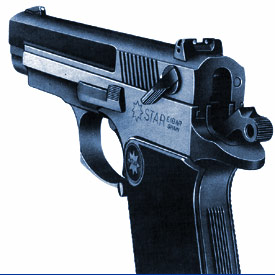
The Model 28 heralded an entirely new direction for Star. This was the beginning of an era of home-grown designs, rather than simple modifications to other platforms. Shortly, the Browning-derived weapons upon which Star had built its business and reputation for over 50 years would be discontinued as well.
The unique features of the M28 were to be re-used in most subsequent designs. These are:
- Standard calibers — No longer would 9 mm Largo be the primary caliber of most Star pistols. 9 mm Parabellum and other world standard calibers were exclusively used from this point onward.
- Inverted slide rails — The slide is surrounded by the frame, instead of being perched on top and wrapped around small protrusions of the frame. The entire frame is engaged in slide/frame lockup, even the dustcover. This theoretically encourages accuracy and longevity from the longer engagement distance.
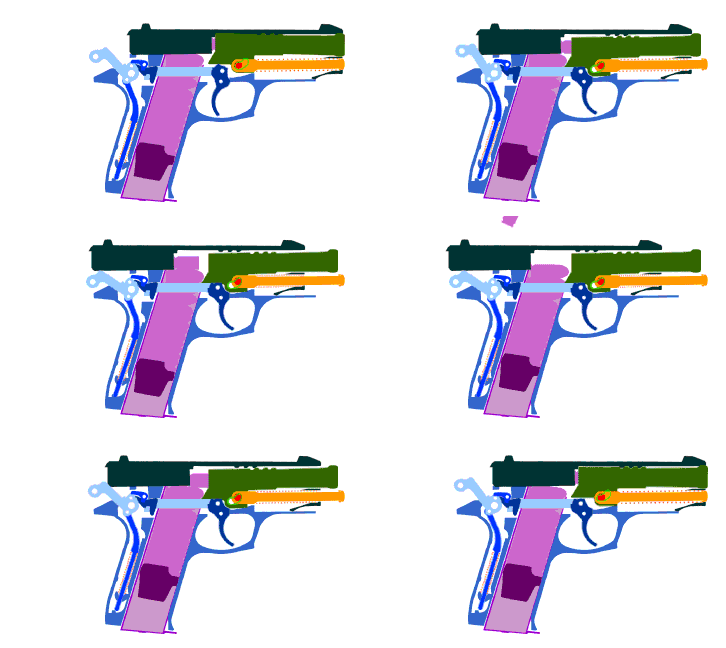
- Closed cam-path locking — Browning style locking is a short-recoil system, where the force of the gun firing pushes the barrel and slide back as a locked unit a short distance. They then unlock and the slide continues its recoil and loading cycle alone. The first version of this, and all non-super Stars used a swinging link. This separate piece of metal was replaced on most guns with a simple ramp. The M28 (and SIG P-210, and CZ-75, and others) use a cam path that entirely controls the action of the barrel, like a link, but with fewer moving parts. The bright green shape under the barrel in this animation highlights the cam path.
- Double-action lockwork — All previous Star pistols were single-action, requiring the pistol to be carried with the hammer back and safety engaged. Conventional double-action pistols can fire the first round with the hammer down, which from the 1970s to the 1990s at least was seen as both safer and more effective for combat or defensive pistols.
- Trigger-pulling safety — Until the M31 and later guns, like the Megastar, modern Star pistols had a safety lever but no decocker. The hammer stayed cocked when on safe, which completely blocked the firing pin, but allowed the trigger to be pulled and to release the hammer. Even when decockers appeared, they were an optional position after this same safety position.
- No screws and few pins — The model 28 pistol can be disassembled almost entirely with only pieces attached to the weapon. The slide stop has a smaller diameter end piece that can be used to remove the hammer stop and remove the firing pin, and to depress the backstrap plunger, which releases the grip panels. All small pins (as for the extractor) are sized so the firing pin can be used as a punch (but, firing pins are fragile and critical to operation, do don't do this!). Only a few screws are used, such as for adjustable sights and the magazine release. The advantage is of course that soldiers in the field can fix issues and clean weapons without bringing extra tools. Also, screws cannot come loose and be lost, putting a weapon out of service.
- Captured recoil spring — The recoil spring is retained by a bushing and pin, instead of being readily removable from the guide rod. This makes basic assembly and disassembly easier and there is less chance of loss of parts.
Manuals & Disassembly Instructions
I do not have manuals for every pistol shown on this site. However, in many cases there is a related manual. Partly to make the series relationships clearer, and partly to assist with speed and accuracy of updating, all manuals can be found in one place, the manuals page. All manuals available are provided as downloadable PDFs, or you may purchase a printed copy of the entire set of handgun manuals.
Ancestry of the M28
These features, taken as a whole, have led many observers to decide that Stars of this era are all derived from the CZ75. Though I have never been in contact with a Star weapons designer, I believe this to be untrue, and that the Star designs are derived from 1930 Swiss pistols instead. A number of subtle details of design suggest to me that the Star engineers were looking at SIGs. Of course, the most telling point is that the CZ-75 was first offered for sale in 1975, whereas Super style Stars with closed-cam unlocking were made from the late 1940s onward.
Though it would be nice to declare that Star simply invented the more interesting features, all of them see to be able to be traced to Charles Petter designs of the 1930s. His SACM pistol, adoped by the French in a unique and anemic cartridge as the Mle. 1935A, had many of the features found in later Star pistols, including the captured recoil spring and removable lockwork. On almost all other weapons, including the CZ-75, the lock pieces are individually retained in the frame and removal is a non-trivial procedure. On the SACM, SIG210 and modern Stars the hammer, sear, and so on can be easily removed from the frame as a single unit. The M28 (and most others that followed) have a removable backstrap, whereas the Swiss guns had the lockwork contained in a small housing inside the frame, but the principle is the same, and is not found otherwise.
The SIG 210 is a direct decendent of Petter's SACM pistol, but subsequent SIGs mutated into a series of similar and rather conventional pistols.
Model 28
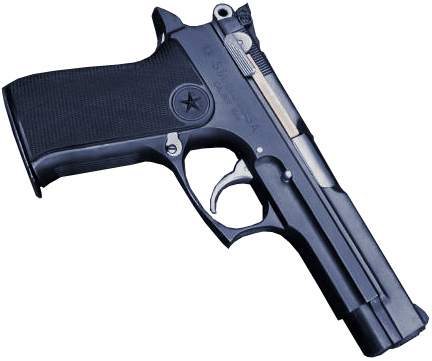
The Star Model 28 was one of the first of what quickly came to be known as the "wondernines." These were any double-column, high-capacity, double-action 9 mm Parabellum handguns. They were intended to trade total firepower (volume of fire) for caliber and to be easy for less-trained individuals to use.
The other pistol which can claim to be the first "wondernine" is the French MAB PA-15. This pistol was adopted for service in the early 1980s, and is just now being drawn down. The M28 was itself never adopted, but tried very hard to get there.
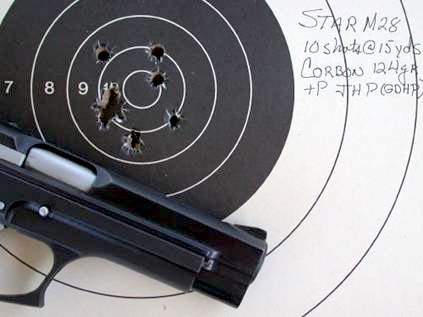
The Model 28 was developed more or less specifially to meet US requirements for a universal service pistol. It was one of the few entered into the first JSAAP contest, from which – eventually – the Beretta 92 was crowned the M9 service pistol. In this first trial, the M28 showed very, very poorly, stopping an average of every five rounds. Though this has been sometimes blamed on ammunition, one suspects that a military service pistol should be very tolerant of ammunition. Other weapons entered also did extremely poorly, especially US-made guns. The Smith & Wesson entry kept shedding its front sight, and a Ruger entry broke links, just for two examples.
Only relatively few of these were built and sold commercially, and they all seem to perform just fine. I have never heard of a complaint from an owner of an M28. Star did not enter the second round of JSAAP testing, partly because their redesigned gun had been accepted for Spanish service and they were busy enough filling those orders (see M30, below). The Model 28PK was also reportedly a standard service arm of the National Police, though due to age, these have been replaced with the USP Compact.
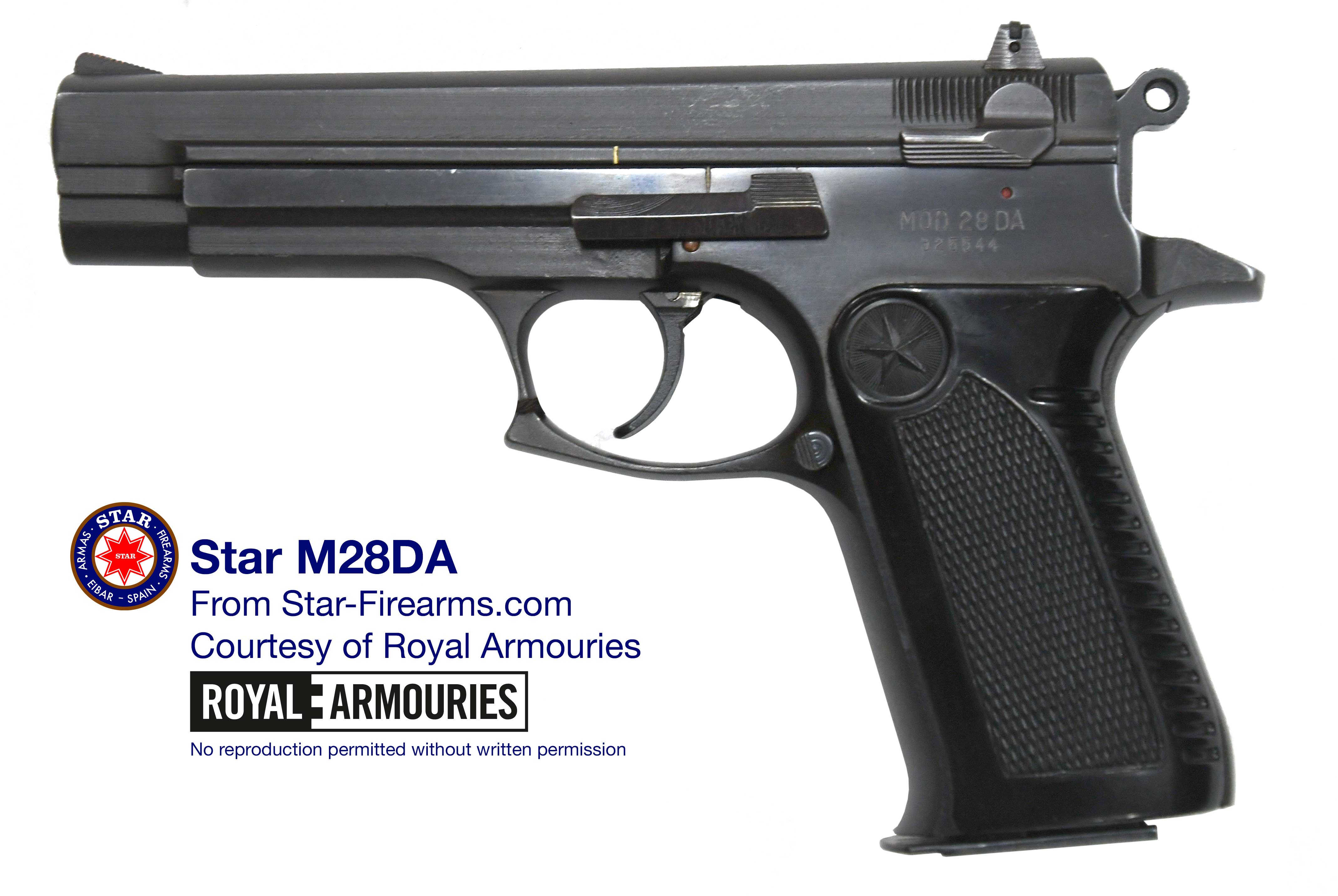
The Model 28 is basically similar to any of the many double-column, double-action pistols on store shelves today. The most innovative or unusual features have been covered above. Another feature required of many service pistols in this era became a loaded chamber indicator. This has settled into being combined with the extractor, but other methods were also tried at first by many makers. The model 28 uses a large bar at the 12 o'clock position, right on top of the slide. This is configured exactly like an extractor, but has no hook, and simply pops up slightly when a cartridge case is in the chamber. It can be seen and felt by the user to check the loaded condition. The more conventional indicator/extractor function was used in the later variations.
Model 28DA
The Royal Armories has a Model 28 which is marked "28DA." I couldn't inspect it in detail sufficiently to tell if there is any difference from the no-suffix Model 28 internally, but there is nothing obvious from a cursory examination.
"28/30" Hybrids
One of our readers has revealed an apparently transitional model he obtained from a major South African distributor. It has the frame, including marking, of an M28PK, but with a clearly M30PK slide and other upper components. While such transitional firearms are common for other manufacturers, and may have taken place with some early and wartime Stars, this is the only modern-era Star I have encountered like this.
Model 30
The Model 30 is really the heart of this series, and fixed all the issues and oddities of the M28. Though a few other detail changes also took place, the primary difference is in removing the loaded-chamber indicator from the top of the slide, and changes to the configuration of the extractor. This extractor also serves as a loaded chamber indicator. The magazine catch was updated, likely to better meet requirements of other service pistols, to be changeable for ambidextrous use, and slightly updated magazines provided. Note that ambi magazines will not operate in M28 pistols.
In its improved form, this pistol was adopted for service by a number of Spanish police organizations, and the Spanish armed forces. As I understand it, the police adopted the PK and the military the M versions. Here, PK means Police length (shorter) and aluminum, whereas M means military or longer and without the K suffix, is simple steel-framed. Spanish Air Force pilots also apparently used PK versions, and some Guardia personell used the M also. The Guardia Civil is a paramilitary organization and is both police and military, so this is a frequent source of issued-weapon confusion. The M30 was also adopted in some numbers by Peruvian police and security forces.
Clarification on Spanish Service weapons
In the United States, and several other countries, when a military weapon is adopted it is made standard and practically everyone who uses a weapon of that class will use the new issue weapon as soon as enough are purchased. In many other countries, this is not how it happens. Instead, a number of weapons may be classified as service-acceptable and contracts are given for smaller runs based on price, special needs at the time and so on. The Germans do this; any P-series pistol (P5, P7, P9) indicates that it is classified as an acceptable police weapon.

On the other hand, police forces in the US and some other countries are decentralized, and there is no such thing as a standard police pistol. The tens of thousands of individual agencies are free to choose their own weapons. Other countries either have a centralized police force, or have a centralized standards-setting body. In these places, such as Spain, adoption as a police pistol guarantees large sales.
Readers in the Spanish armed forces have confirmed issuance of Star pistols as late as the 20-teens. However, they are mostly over 30 years old, with no real possibility of replacement, a serice-life-extension, or even replenishment of spares (due to Star going out of business). The Marines and National Police have switched to an HK pistol, the Guardia uses Berettas, and the Catlonian Police use Walthers. However, the Spanish Navy still broadly issued (as of 2008) the M30 series for force protection duties, and others must certainly be hanging on today (in the 2020s). As the Spanish Navy still issues 1960s-era Star SMGs (in very nice condition, as well) these pistols may also be expected to remain in at least second-line service for decades to come.
The "Colt-Hartford" M30s
Much like the abortive Colt Pony Model D there was, apparently, a deal explored by Colt in the late 1980s to import Star M30 pistols and sell them under the Colt name. This would be the era of the failed Colt Double Eagle and eggregious (and recalled) All American 2000, which Colt was casting about for something to compete with the likes of Beretta and Glock.
Colt purchased 10 model M and 10 model PKs in 1986, for some sort of internal evaluation. It is surmised that this was part of the followon to the JSAAP competition. Remember, despite the Beretta 92FS being declared the M9, there were many competitor claims filed, and a lot of political gnashing of teeth over adopting a funny foreign gun. It seemed likely for a bit there that the DOD might open up to a third round of testing, and you can imagine Colt deciding to submit this entirely functional gun as a "U.S. Made" pistol to the competition.
The pistols appear to be completely unchanged except for markings, bearing "COLT-FIREARMS HARTFORD, CT" on the right side, just above the normal rollstamping from the Eibar factory. The Ms seem to have pin stamps, the PKs are roll stamped. Colt directly imported them from Spain, so these are the importers, not makers marks.
After a short time, Colt became uninterested, and sold them all off to the employees, who bought them up pretty quick. They come up for auction periodically, and command rare Colt prices.
Model 30 MI
Though Star did not generally give customer-specific suffixes, it is a common in the defense industry, and in this case they did.
RCMP's Firearms Reference Table indicates the pistols are for the Indian market, and a 1997 Star factory letter to Glen Rostron states that the M30MI is "exactly the same" as the 30M, and was "was going to be destined" for a contract in India, presumably indicating that it was not filled.
Several of the 30 MI variants are also stamped "Starfire," which was a commercial label used to sell the M30 series off and on. I have no idea if this was part of the original contract or a name they added after the contract was cancelled to make themselves happy they were switching from a contract run to commercial sales, or something else.
Model "Starfire"
The Model 30 was sold, at least in the US under the "Starfire" brand name as well. This seems to have become a generic name for all M30 pistols for some time, and is frequently encountered in value books for example. However, most M30s are not stamped "Starfire" so use the value books carefully in this case.
Model 30M Target
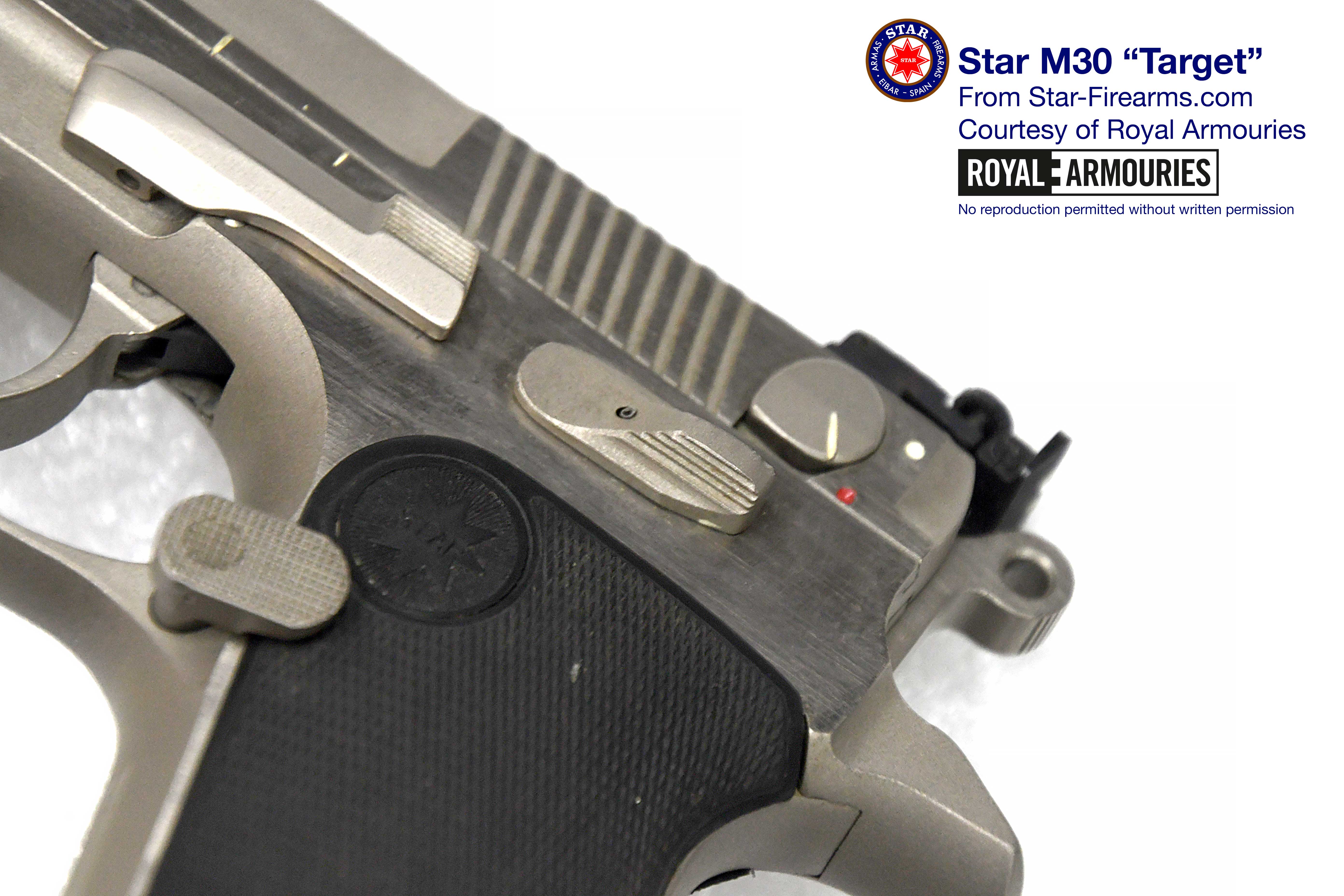
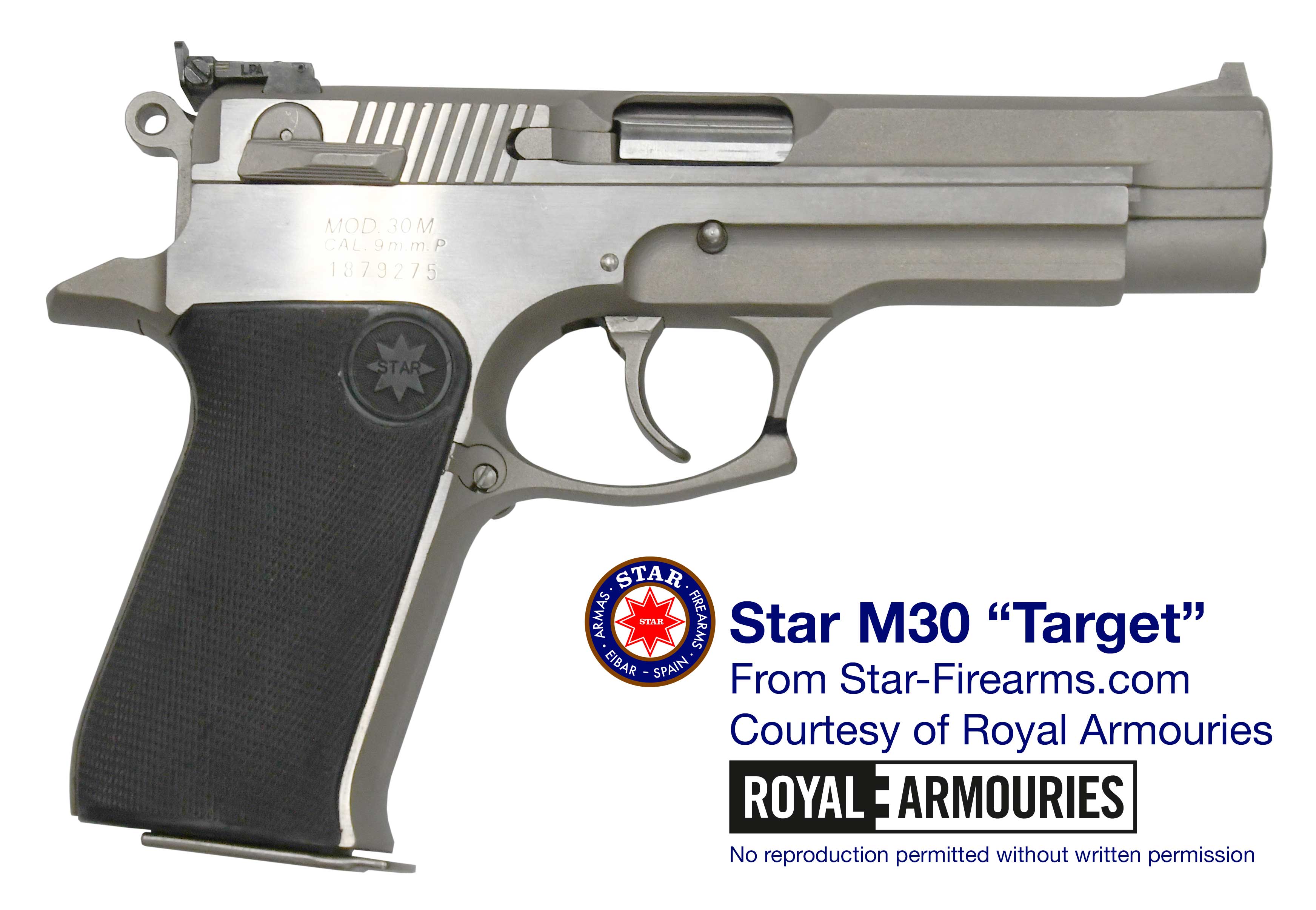
Target models of the Model 30 are similar to those made from European service pistols generally: single action, better sights, extended magazine releases, and often a frame mounted safety. The Star M30 Target is only made from the steel-framed M model, and has improved sights with a taller front blade and adjustable Bo-Mar like rear, and an enlarged and extended magazine release.
It is single action only, with the slide mounted safety lever blocked off on the left side. The right side slide mounted safety lever is retained and functions, presumably as it is needed to fully strip the pistol. The marks on the left side of the slide are retained, even filled with paint.
In addition, a frame mounted safety is mounted to the left side, and locks the hammer from all movement when engaged.
Target models were made in both Starvel and blue steel, and both came with the basic finely-checkered black rubber-over-plastic stocks in the format of the duty pistols. There are no marks on the pistol to designate this is a Target variation.
I have handled the Starvel example in the Royal Armories collection, and found the safety lever not especially well-positioned or positive in action, and the trigger not especially good for a target pistol.
There appear to be no target versions of the Model 28 or 31 although with the customization that the Star factory did, and somewhat iffy recordkeeping, I would not be surprised to find they exist in at least small numbers. If you have one, or see one and can get a photo, send it over!
Model 31
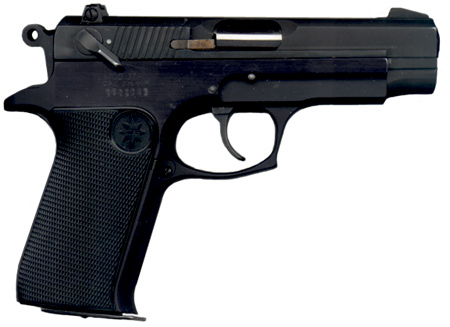
The model 31 is an extensive update to the model 30 series, and saw some commercial sales before the closure of the Star plant. I know of no military or police sales, but cannot rule them out either. It was made in the usual variants, both PK and M. Although a letter from the factory at the time assured me there were no "MK" or "P" variants, at least two readers have shared photos of their clearly-marked M31Ps, sharing all the relevant features.
M31 pistols were made in both "blue" phosphate finished steel and anodized aluminum frames for the PK models, and in Starvel, or nickel-plated versions. While common in other modern era Alloy-framed pistols, all but one Starvel M31 I have encountered is steel-framed, with no plated or bright-anodized PK models.
The 31 varies from the 30 in a few details of design, including minor frame and slide contours, and the shape of the safety lever. Most parts continue to be interchangable with the models 30 and even 28. Note that on the parts list the first two values indicate the original series, and several parts still start with "28." The main changes are to the barrel and safety lever operation, but a number of the internal pieces have changed, and the extractor was modified yet again. The extractor is a shorter piece, that rotates over a larger angle, and is very similar to that used on the Firestars. In fact, the extractor spring is the same as that used on the M43.
The barrel of the model 31 is "coned," or wider at the front, with an expanded spherical bushing at the extreme muzzle end. Browning-lock pistols tilt the barrel when locking to battery. A tight and consistent lockup is critical to repeatable accuracy. Previous models used the usual method with as straight tube barrel and a bushing pressed into the slide which impinges on the barrel. Coned barrels essentially reverse this arrangement, and are supposedly more accurate, especially over time.
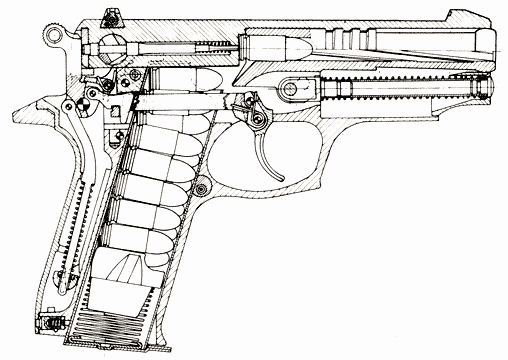
The safety lever operates as it has always done, by blocking the firing pin and allowing the trigger to be pulled and the hammer to fall. There is also an additional position, if the lever is pushed past safe. This decocks the weapon (dropping the hammer for you), and is a spring-loaded, temporary position. When the user releases the lever, it springs back to the safe position. If you release it very smartly, the lever will flip back all the way up to the fire position, which I find to be a feature, not a bug.
Model 31s in .40 S&W Caliber
When the .40 S&W cartridge emerged in 1990, Star jumped on the bandwagon with numerous other companies and rapidly threw out a .40 version of an existing gun. The M31M in .40 does not seem to have been heavily produced. It is possible only a few hundred were made, in fact. They had significant reliability issues (as many of the early .40 modified pistols did by other makers).
Most of the few made were M31M models, in steel, presumably to handle the extra recoil of the larger bullet, but at least a few M31Ps were also produced. This is exceedingly unusual as the 28/30/31 series do not have model Ps, but only PK. Yet a small number of full sized alloy frame .40 caliber M31s exist.