Star Firearms
All weapons listed on this site are grouped into one of about 20 groupings. These groups are of my own devising, and while as accurate as I can make them, are not precisely picked up from the factory. I could be wrong. I have been in the past.
Below is a simple list of all the classes. Most are self-explanatory, but if you have trouble figuring out which gun is yours, go to the next tab on finding your model number.
Early (1905 - 1926)
Classic & Super (1924 - 1983)
Vest-Pocket & Target (1928 - 1983)
Modern (1979 - 1997)
Compact and Carry Pistols
Firestars- Firestar M40, 43 & 45
- M243 Firestar Plus
- 9 mm & .40 S&W
- M105 Prototype
Sub Machine Guns (1935 - 1997)
Military, Police and Paramilitary SMGs
-35 Series- Si-35
- RU-35
- TN-35
- Z62
- Z63
- Z70
- Z70/B
Rifles
Some basic information about Star firearms
A lot of the time I spend answering questions — I mean good questions, by people who at least try to read the site — is communicating some basics about how Star made or sold pistols,
I am not going to cover information detailed other places, like how to find your model number, how to find the date of manufacture, and other stuff. Look at the tabs across the top for these. Parts, spares and accessory dealers are in the Information tab.
Star "Model SA"
You don't have a Model SA or S.A. That's the name of the company, "Star, Bonfacio Echeverria S.A." The SA part stands for Sociedad Anónima or "Anonymous Society." Kind of like Inc. or Corp. in the US, where it means the shareholders and operators of the corporation are not individually liable. Want to find the model number?
Star "1911s"
There are no Star 1911s, or 1911 copies, clones, knockoffs or what have you. The Classic series (the Model A and B especially) look very 1911-ish, but they are only stylistically similar, and have a swinging link. They were developed independently, and derive from guns developed before the Brownings existed, or were well known, but later migrated to take some stylings from this popular pistol. Zero parts interchange, and most Star "1911" pistols are in 9 mm calibers as well.
Commercial vs. government issue
The Star factory considers most guns to be in one of two categories, either "commercial" or "military." Military means government issue, really, and includes the Guardia, and all domestic police forces as well as the conventional armed forces. Domestic is the critical word here. Firearms built for issue to a government outside of Spain are still generally considered to be "commercial" models. This is why the "Miliary" Model 1921 and the "Commercial" Model B can both have been issued to government troops.
To keep things simple, for myself mostly, I use these terms in the Star manner, so don't be confused.
"Super" models
Almost all "classic" era Star pistols, the basically-1911-looking guns, were made in both original and Super variants. The original series employs a Colt/Browning swinging link, while the Super series use a Sig/Petter closed cam path system. The super models were almost always sold alongside the original style pistols, and did not supplant them. They are easily identifiable, aside from markings, from the swinging takedown lever on the right side; conventional pistols will require removing the slide lock pin entirely as older Browning pattern guns do.
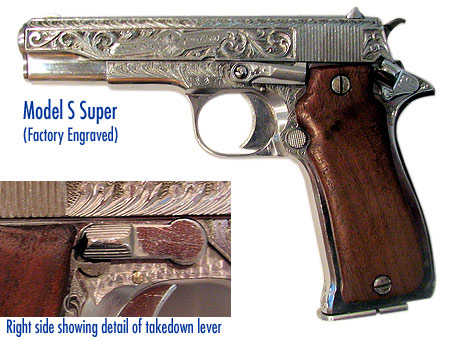
Engraved and other custom work
The Star factory continued the traditions of Spanish arms makers in their love of the custom arm as well. There are many examples of finely engraved Star pistols, especially smaller guns as presentation pieces. The degree of customization and intricacy varies a great deal. The factory entertained true custom orders, but the best of these rarely pop up on the secondary market, and do generally command a significant price premium. Many, many guns were also made with semi-custom features, such as plated controls, special finishes or minor engraving. As Stars are not collectable, these generally bring no premium at all. If you want to start a collection, look for really nice Spanish handguns.
As a general rule, "pretty" customization, such as plating, anodizing and engraving can be assumed to come from the Eibar factory. Functional modifications (enlarged slide stops, magazine floorplates) will be aftermarket.
Importers
Okay, this one is covered other places, but I'll touch on it here. If a firearm was not built in your country, it was imported. In the US at least, and aside from special cases like war trophies in the distant past, this was done by an officially licensed importer. Importers have to stamp the gun with their identifying information and become in some legal ways the manufacturer in the US. These importers marks should never be confused with the manufacturer info; there are no Interarms Model B pistols, actually or legally. Also, importers are usually very large dealers. Sometimes, special packages are made up for these dealers, of custom guns that are not necessarily cataloged otherwise. This adds a lot of confusion; a weird variant will suddenly become very common as a stockpile of some special order will appear.
Methods of operation
There are numerous methods by which a locked- or delayed-breech pistol may operate. The most common are short-recoil systems, and the most common of those are the tilting-barrel systems.
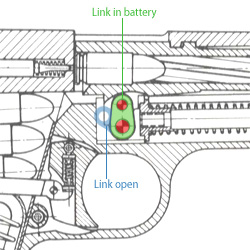
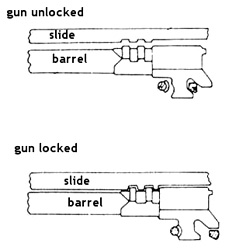
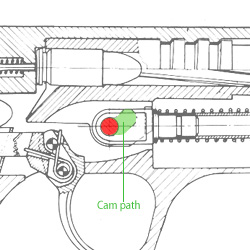
Stars employed two of the three most useful and common systems of tilting the barrel. In each of the diagrams below the red dot is the action pin – often the stripping pin – locked to the frame, which acts as the barrel cam pivot point. The green area is the path the it takes during travel. All diagrams are shown in battery.
 |
 |
 |
Colt-Browning Swinging LinkThe barrel is tied to the operating pin with a link, pivoting at the barrel end as well. Rearward movement of the slide on firing moves the barrel which causes the link to pull the barrel down and out of engagement with the slide. The barrel stops at the loading position, while the slide continues to eject the casing and absorb remaining recoil. This is the earliest really functional system, but limits how the designer can adjust the mechanism as the path is always an arc.Best known from the Colt 1911, and therefore used on Star Models 1920 and '21, and all Classic series Star pistols. |
Browning RampThe general method of operation is identical, with the barrel tied to the slide and slowly pulled out of engagement. However, the camming mechanism is integral with the barrel (or barrel extension). A a slot is cut at an angle into the bottom of the barrel extension, which engages with surfaces machined into the side of the frame, the end of the spring guide rod, or other parts. This allows the designer some control over the speed of unlocking, without changing the height of the barrel, as is the case for the swinging link.The High Power, Smith & Wesson automatics, and most modern designs (Sig, Glock, HK) have settled on this pattern due mostly to simplicity of manufacturing, requiring only flat surfaces be cut and finished. |
Petter Closed Cam PathThis merges the one-piece concepts of the ramp with the smooth cam action of the swinging link, and machines a cam path into the lower barrel extension. The stripping pin is inserted through the cam path, and acts as the guide pin as on the swinging link, but the path can be designed to unlock the gun at different speeds at different portions of the slide travel; this theoretically allows for a smoother action, tuned to the firearm, slide weight and caliber much more so than any other system.Devised by Charles Petter and first offered in the SACM, this is best known in the Sig 210, CZ-75 and it's ancestors, and the modern Star pistols. To see this in action, check out this animation I created long ago (so, it is very low res these days) of an M30 pistol. |
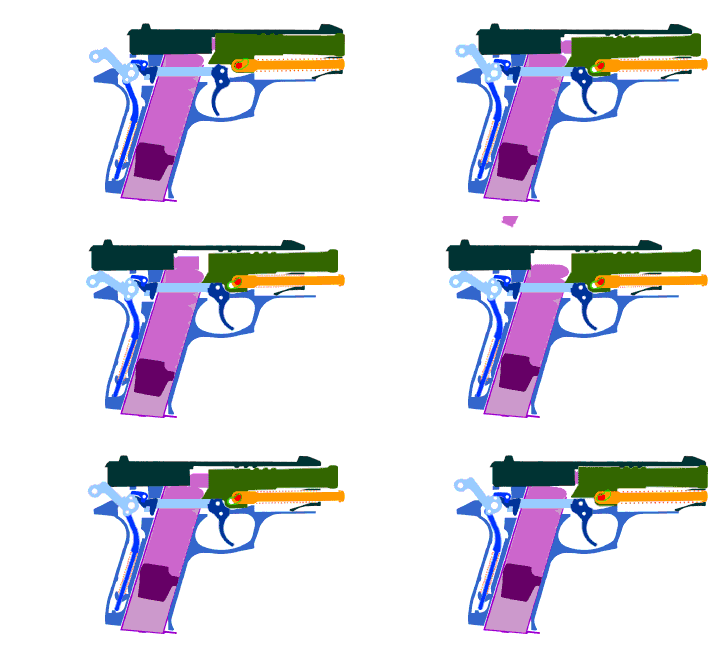
Other variations, such as whether the lockup with the slide is via barrel rings or the barrel hood and ejector port, are fairly minor and not expressly mentioned.